Container Gardening Supplies
Container Gardening Supplies: Here's the most important items you'll need to start your Container Garden... and be successful.
Appropriate Containers
In your Container Gardening Supplies, pots are available in many sizes, shapes, and materials.
All containers, whether clay, wood, plastic, or ceramic, should have an adequate number of holes in the bottom for proper drainage. Additional holes should be drilled or punched in containers that do not drain quickly after each watering.
Setting the container on a solid surface, such as a cement or patio floor, reduces drainage. Raising the container one or two inches off the floor by setting it on blocks of wood will solve this problem.
The container's size will be determined by the plant selected. Generally, most plants grown in the soil can be grown in containers as long as ample space is provided for them to develop roots. Shallow-rooted crops like lettuce, peppers, radishes, herbs and most annuals need a container at least 6 inches in diameter with an 8-inch soil depth.
Your container gardening supplies could also include, bushel baskets, half barrels, wooden tubs, or large pressed paper containers are ideal for growing tomatoes, squash, pole beans, cucumbers, and deep-rooted perennials.
Media
A fairly lightweight mix is needed amongst your Container Gardening Supplies. Soil straight from the garden usually cannot be used in a container because it is too heavy, unless your garden has sandy loam or sandy soil.
Clay soil consists of extremely small (microscopic) particles. In a container, the bad qualities of clay are exaggerated. It holds too much moisture when wet, resulting in too little air for the roots. Also, it pulls away from the sides of the pot when dry.
Container medium must be porous in order to support plants, because roots require both air and water. Packaged potting soil available at local garden centers is relatively lightweight and may make a good container medium.
For a large container garden, the expense of prepackaged or soilless mixes may be quite high. Try mixing your own with one part peat moss, one part garden loam, and one part clean coarse (builder's) sand, and a slow-release fertilizer (14-14-14) added according to container size.
Lime may also be needed to bring the pH to around 6.5. In any case, a soil test is helpful in determining nutrient and pH needs, just as in a large garden.
Fertilizer
Fertilize plants with the recommended rate of a water-soluble fertilizer every two to three weeks.
An occasional application of Bionide fish emulsion or compost will add trace elements to the soil. Do
not add more than the recommended rate of any fertilizer.
Doing so may cause fertilizer burn and kill your plants. Unlike garden plants, container plants do not
have the buffer of large volumes of soil and humus to protect them from over-fertilizing or
over-liming.
Wolf Garden Tools
We absolutely LOVE the red and yellow Wolf Garden tools collection.
The interchangeable handles mean you can switch to a short handle, for working in a window box or raised bed, then back to a longer handle for ground-level work.
Wolf Garden has more than a dozen different tools suitable for box or container gardening, including rakes, hoes and cultivators.
Water Requirements
Pay particular attention to watering container plants. Because the volume of soil is relatively small, containers can dry out very quickly, especially if they are on a concrete patio in full sunlight. Daily or twice-daily watering may be necessary. Apply water until it runs out the drainage holes.
Water clay pots and other porous containers more frequently, as they allow additional evaporation for the sides of the pots. Small pots also tend to dry out more quickly than larger ones.
If the soil appears to be getting excessively dry (plants wilting every day is one sign), group the containers together so that the foliage creates a canopy to help shade the soil and keep it cool.
Check containers at least once a day and twice on hot, dry, or windy days. Feel the soil to determine whether it is damp.
Mulching and windbreaks can help reduce water requirements for containers. Consider installing an automatic trickle irrigation system if you plan to be away for extended
periods.
Light Requirements
The amount of sunlight your container garden spot receives may determine which crops can be grown. Check light requirements for specific plants.
Available light can be increased somewhat by providing reflective materials, such as aluminum foil, white-painted surfaces, and marble chips, around plants.
Return From Container Gardening Supplies
To Container
Garden Home Page
Must-See
Container Garden Ideas!
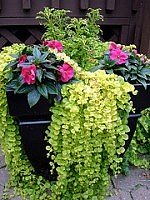
25 Incredible Container
Designs
You Can Do At Home
Bizarre Planters!
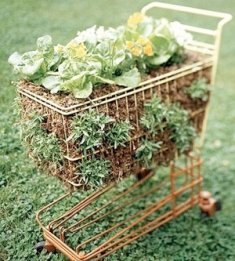
Reduce, Reuse, Recycle: Container Gardens in Shopping Cart, Broken Doll, Barbie Car and More!
Names of Flowers
Made Easy
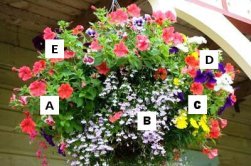
What's That Flower Again?! Find Your Favorites With Our Easy-to-Use Labeled Layouts
Step-by-Step Container Vegetable Gardening
Simple and Stunning Container Recipes!
You Won't Need Green Fingers to Arrange These Layouts at Home